 Epic Heroes Entertainment Media | Pop Culture Reviews Pure Escapism !
Top 10 Comedy Movies of all Time . Must Watch List !!
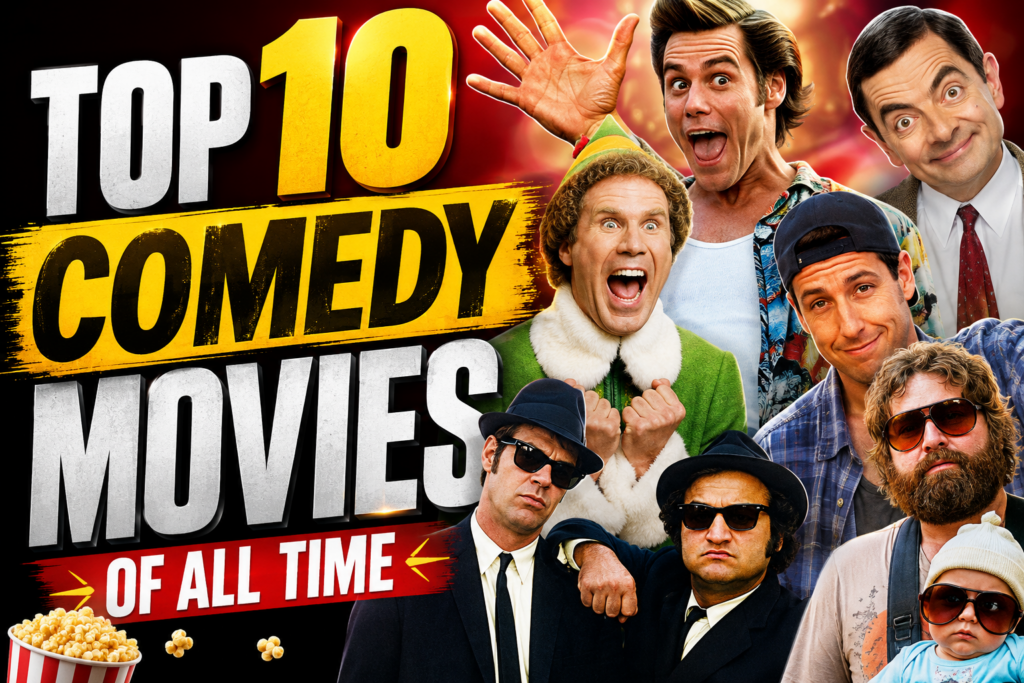
#top10 #comedy #movies of all Time .
The Greatest Comedies Ever Made, Ranked
Top 10 Comedy Movies – Comedy is one of the most enduring genres in cinema. A great comedy can make audiences laugh until they cry, deliver unforgettable characters, capture the spirit of an entire generation, and remain just as entertaining decades after its original release. From outrageous slapstick and clever satire to romantic misunderstandings and brilliantly written dialogue, the Top 10 Comedy Movies offer something for everyone.
But what makes a comedy movie one of the greatest of all time? Is it the number of laughs, the quality of the performances, the originality of the story, or its influence on the films that followed? The most memorable comedies combine several of these elements, creating movies that audiences return to again and again.
The history of Top 10 Comedy Movies stretches from the silent-film era to modern Hollywood blockbusters. Legendary performers such as Charlie Chaplin and Peter Sellers helped establish comedy as an art form, while filmmakers including Mel Brooks, John Landis, Ivan Reitman, and the Farrelly brothers brought their own distinctive styles to the genre.
Meanwhile, movies such as Groundhog Day, The Big Lebowski, Airplane!, and Monty Python and the Holy Grail demonstrated that comedy could be surreal, philosophical, absurd, or completely unpredictable.
In this countdown, we rank the top 10 comedy movies of all time in descending order, starting at number 10 and working towards our number one choice. The list considers humour, storytelling, memorable performances, cultural impact, originality, and lasting entertainment value.
Whether you love classic Hollywood comedies, British humour, romantic comedies, or outrageous American comedy films, these Top 10 Comedy Movies represent some of the finest examples of the genre.
CLICK THE STREAM LINKS TO WATCH NOW
10. The Big Lebowski (1998)
Director: Joel Coen
Starring: Jeff Bridges, John Goodman, Julianne Moore, Steve Buscemi, and Philip Seymour Hoffman
Genre: Crime comedy, black comedy, cult comedy
Why it ranks among Top 10 Comedy Movies : Unforgettable characters, surreal humour, endlessly quotable dialogue, and a story that becomes more ridiculous with every twist.
Few comedy movies have developed a cult following quite like The Big Lebowski. Released in 1998, this offbeat crime comedy from filmmakers Joel and Ethan Coen initially divided some audiences but gradually became one of the most celebrated cult films in modern cinema.
The film follows Jeffrey Lebowski, better known as The Dude, a laid-back Los Angeles resident whose greatest ambitions involve drinking White Russians, bowling with his friends, and avoiding unnecessary complications. His peaceful existence is interrupted when two criminals mistake him for a wealthy businessman who shares his name.
After damaging his rug during their visit, The Dude seeks compensation. What initially appears to be a straightforward misunderstanding soon develops into a bizarre investigation involving kidnapping, eccentric millionaires, suspicious associates, and increasingly confusing criminal schemes.
The story deliberately refuses to follow the conventional rules of a detective thriller. Instead, it embraces absurdity, unexpected digressions, and characters whose motivations are often difficult to understand. The more The Dude attempts to make sense of the situation, the more chaotic everything becomes.
Why The Big Lebowski Is So Funny
Jeff Bridges delivers one of his most distinctive performances as The Dude. His relaxed manner, philosophical indifference, and bewildered reactions make him a perfect centrepiece for the film’s unusual comedy.
John Goodman is equally memorable as Walter Sobchak, The Dude’s volatile bowling companion. A Vietnam War veteran with an explosive temper and an unwavering commitment to his own interpretation of the rules, Walter turns even the simplest conversations into potential confrontations.
Steve Buscemi adds another layer of humour as Donny, the quiet friend who frequently finds himself caught between The Dude’s passivity and Walter’s aggression.
The chemistry between these characters is one of the film’s greatest strengths. Their bowling conversations, arguments, and increasingly strange adventures create a comic rhythm that feels entirely unique.
The Coen brothers also fill the movie with bizarre supporting characters and surreal sequences. Every new encounter introduces another eccentric personality, unexpected complication, or absurd misunderstanding.
The result is a comedy that rewards repeated viewing. Many of its funniest moments emerge from small details, subtle reactions, and dialogue that becomes even more entertaining once viewers know where the story is heading.
Cultural Impact and Legacy
Over time, The Big Lebowski became a major cult phenomenon. The Dude’s relaxed philosophy inspired countless references, costumes, quotations, and celebrations of the character’s unusual worldview.
The film also demonstrates how comedy can challenge traditional storytelling. Rather than building towards a conventional heroic victory, it creates humour from confusion, failure, coincidence, and the ridiculous nature of everyday life.
Although its unconventional structure may not appeal to every viewer, its originality and unforgettable characters secure its place among the Top 10 Comedy Movies ever made.
For anyone who enjoys offbeat humour, eccentric characters, and crime stories that never take themselves too seriously, The Big Lebowski remains essential viewing.
9. Groundhog Day (1993)
Director: Harold Ramis
Starring: Bill Murray, Andie MacDowell, and Chris Elliott
Genre: Fantasy comedy, romantic comedy
Why it ranks among the Top 10 Comedy Movies: An ingenious premise, superb comic timing, emotional depth, and a message about personal growth that never feels forced.
What would happen if you had to live the same day repeatedly, knowing that nothing you did could change tomorrow?
That question lies at the heart of Groundhog Day, the 1993 comedy that transformed a simple fantasy premise into one of the most inventive and meaningful films of its era.
Bill Murray stars as Phil Connors, a cynical television weather presenter assigned to cover the annual Groundhog Day celebrations in Punxsutawney, Pennsylvania. Phil considers the assignment beneath him and makes little effort to hide his contempt for the town, its residents, or his colleagues.
After reporting on the event, Phil discovers that he is trapped in a mysterious time loop. Every morning, he wakes up to the same song on the radio, experiences the same conversations, and relives February 2 all over again.
At first, Phil treats his situation as an opportunity to escape the ordinary consequences of his actions. With no apparent tomorrow, he experiments with increasingly selfish and ridiculous behaviour.
However, the novelty eventually disappears. The repetition becomes exhausting, and Phil must confront the emptiness of his own existence.
Bill Murray’s Career-Defining Performance
Bill Murray is the perfect choice for Phil Connors. His dry delivery, sarcastic observations, and ability to communicate frustration through a facial expression make the early stages of the time loop consistently funny.
The film finds endless comedy in repetition. Familiar conversations acquire new meanings as Phil learns how to manipulate situations, anticipate people’s reactions, and turn ordinary encounters into elaborate schemes.
One of the funniest aspects of the story is watching Phil gradually master his environment. He knows what people will say before they say it and begins exploiting his knowledge for increasingly absurd purposes.
Yet Murray’s performance also gives the film its emotional weight. As Phil’s amusement turns into despair, the comedy becomes more reflective without losing its charm.
Andie MacDowell provides a warm counterbalance as Rita, Phil’s colleague. Their developing relationship becomes central to his transformation, although the film wisely avoids suggesting that romance alone can solve his problems.
More Than a Time-Loop Comedy
What makes Groundhog Day exceptional is the way its premise supports a genuine character journey.
Phil initially wants to escape his circumstances without changing himself. Eventually, he begins learning new skills, helping people, appreciating art and music, and paying attention to the lives around him.
He discovers that the most meaningful use of his repeated day is not manipulating other people but becoming someone capable of contributing to their happiness.
The film’s message remains remarkably universal: although people cannot control every circumstance, they can often choose how they respond to it.
This theme has inspired philosophical discussions about happiness, habit, personal responsibility, and the meaning of life. The phrase “Groundhog Day” has even become a common way of describing repetitive situations.
The movie’s influence extends well beyond comedy, with its time-loop concept inspiring countless later films, television episodes, and stories.
Despite its supernatural premise, the emotional journey feels recognisably human. Most people understand the experience of feeling stuck, repeating mistakes, or waiting for life to improve without making meaningful changes.
Groundhog Day suggests that transformation begins when we stop blaming our circumstances for everything and start examining our own choices.
Funny, thoughtful, romantic, and surprisingly moving, it is one of the most complete comedy films ever produced.
8. Airplane (1980)
Directors: Jim Abrahams, David Zucker, and Jerry Zucker
Starring: Robert Hays, Julie Hagerty, Leslie Nielsen, Robert Stack, and Lloyd Bridges
Genre: Parody, slapstick comedy, disaster-film spoof
Why it ranks among the Top 10 Comedy Movies. Relentless visual gags, brilliant deadpan performances, outrageous wordplay, and an extraordinary density of jokes.
If comedy were measured by how many jokes could be squeezed into a single scene, Airplane! would be one of the strongest contenders for the greatest comedy movie of all time.
Released in 1980, this aviation disaster parody transformed the conventions of serious disaster films into a nonstop sequence of absurd misunderstandings, visual gags, ridiculous dialogue, and increasingly outrageous situations.
The story follows Ted Striker, a former military pilot struggling with his confidence and his relationship with his former girlfriend, Elaine. When Elaine works as a flight attendant aboard a passenger aircraft, Ted boards the plane in an attempt to win her back.
Unfortunately, the passengers and crew become seriously ill after eating contaminated fish. With the pilots incapacitated, Ted must overcome his psychological difficulties and land the aircraft safely.
The basic storyline resembles a conventional disaster movie, but almost every scene is designed to undermine that seriousness.
A Masterclass in Absurd Comedy
Airplane! belongs to the tradition of spoof filmmaking associated with the comedy group ZAZ, whose approach relies on treating ridiculous situations as though they were completely normal.
The film constantly surprises its audience. A serious conversation may be interrupted by an absurd background gag, a seemingly ordinary phrase may acquire a completely unexpected meaning, and a dramatic scene may suddenly become ridiculous.
The humour operates on several levels at once. Some jokes depend on wordplay, while others rely on slapstick, visual absurdity, or references to the disaster movies popular during the 1970s.
One of the film’s greatest strengths is its refusal to pause for laughter. Jokes arrive so rapidly that viewers may miss one while reacting to another.
Robert Hays plays Ted with complete sincerity, allowing the ridiculous events surrounding him to become even funnier. Julie Hagerty brings an equally straight-faced performance to Elaine, while the supporting cast includes several actors known primarily for serious dramatic roles.
Leslie Nielsen is particularly important to the film’s comic style. His calm, authoritative delivery makes his absurd dialogue sound entirely reasonable, establishing a performance style that would become central to his later comedy career.
Robert Stack and Lloyd Bridges also contribute to the film’s escalating madness, demonstrating how effective deadpan acting can be when surrounded by chaos.
Why Airplane! Changed Comedy
Before Airplane!, parody films certainly existed, but this movie helped establish a particularly influential style of rapid-fire spoof comedy.
Its approach influenced later productions that combined literal-minded dialogue, exaggerated physical humour, genre references, and an almost absurd commitment to their own ridiculous premises.
The film also works as a parody because its filmmakers understand the conventions they are mocking. The emergency announcements, romantic tension, heroic pilot narrative, and dramatic atmosphere all resemble the disaster movies that inspired it.
By reproducing those elements and then pushing them to absurd extremes, the filmmakers create comedy that works even when viewers are unfamiliar with the original films.
More than four decades after its release, Airplane! remains an excellent example of how a simple premise can support an extraordinary number of jokes.
It is not subtle, realistic, or emotionally complex in the same way as Groundhog Day. Instead, it succeeds through speed, precision, and an almost limitless appetite for absurdity.
For fans of classic slapstick and joke-packed cinema, it remains one of the funniest films ever made.
7. Monty Python and the Holy Grail (1975)
Directors: Terry Gilliam and Terry Jones
Starring: Graham Chapman, John Cleese, Terry Gilliam, Eric Idle, Terry Jones, and Michael Palin
Genre: British comedy, medieval parody, absurdist comedy
Why it ranks among the Top 10 Comedy Movies : Completely original British humour, unforgettable absurdist sketches, and a fearless approach to parodying history, fantasy, and storytelling itself.
Few comedy films have inspired as many quotations and devoted fans as Monty Python and the Holy Grail. Released in 1975, this uniquely British comedy takes the legend of King Arthur and the Knights of the Round Table and transforms it into a gloriously ridiculous adventure.
The story follows King Arthur as he travels across a fictional medieval Britain, recruiting knights for a quest to find the Holy Grail. Along the way, Arthur and his companions encounter strange villagers, bizarre knights, dangerous creatures, and challenges that frequently make little sense.
However, this is not a conventional medieval adventure. The film gleefully dismantles the familiar rules of fantasy storytelling, turning everything from heroic battles to royal authority into material for comedy.
King Arthur does not always appear particularly heroic, his knights frequently behave like fools, and the quest itself becomes a vehicle for some of the most memorable absurdist humour in cinema.
The Comedy That Made Monty Python Legendary
The film’s greatest strength is its willingness to embrace complete nonsense.
One moment, the knights may be attempting a serious discussion about their quest. The next, they are confronted by a bizarre creature or an argument that makes absolutely no sense.
The famous killer rabbit sequence is an excellent example. A seemingly harmless rabbit turns out to be a terrifying obstacle, creating a hilarious reversal of the audience’s expectations.
Another unforgettable sequence features the Knights Who Say Ni, eccentric figures whose demands make an ordinary quest feel like an absurd bureaucratic nightmare.
Then there is the Black Knight, whose determination to continue fighting despite catastrophic setbacks turns a traditional battle scene into an extraordinary piece of physical comedy.
These sequences work because the performers commit completely to the material. Even when the situation becomes ridiculous, the characters behave as though the fate of the kingdom genuinely depends on what happens next.
John Cleese, Graham Chapman, Eric Idle, Michael Palin, Terry Jones, and Terry Gilliam bring distinctive comic personalities to the film. Their performances combine verbal wit, physical comedy, surreal situations, and the deliberately awkward timing that became a signature of Monty Python.
The film also uses unexpected production limitations as part of its humour. The famous clopping sound of horses is created by coconuts rather than actual horses, turning a practical filmmaking solution into one of the movie’s most recognisable jokes.
A British Comedy Classic That Changed the Rules
Monty Python and the Holy Grail demonstrates that comedy does not always need a conventional structure or a satisfying heroic conclusion.
Its scenes frequently operate like interconnected sketches, and the film’s willingness to break the fourth wall allows it to undermine its own narrative whenever the opportunity arises.
This unconventional approach influenced generations of comedians, writers, filmmakers, and internet culture. Its dialogue continues to be quoted, parodied, and referenced across television, films, and online entertainment.
The movie is also an affectionate satire of medieval legends, religious imagery, social hierarchy, and the tendency of historical adventure stories to glorify their heroes.
Despite its deliberately chaotic style, the film remains remarkably inventive. Many of its jokes have become part of popular culture, while its low-budget visual approach gives it a distinctive charm that polished modern productions rarely reproduce.
For viewers who enjoy British humour, surreal comedy, and fantasy adventures that refuse to take themselves seriously, Monty Python and the Holy Grail is essential viewing.
Its combination of originality, absurdity, and unforgettable comic performances makes it one of the greatest comedy films ever made.
6. Some Like It Hot (1959)
Director: Billy Wilder
Starring: Marilyn Monroe, Tony Curtis, and Jack Lemmon
Genre: Romantic comedy, screwball comedy, crime comedy
Why it ranks among the Top 10 Comedy Movies : Brilliant performances, sophisticated humour, impeccable timing, and a screenplay that remains remarkably entertaining.
Long before modern Hollywood developed its current approach to romantic comedy, Some Like It Hot demonstrated how mistaken identities, romantic complications, and quick-witted dialogue could produce a near-perfect comedy.
Released in 1959, Billy Wilder’s celebrated film follows two musicians who accidentally witness a gangland massacre in Chicago during the Prohibition era.
Joe and Jerry, played by Tony Curtis and Jack Lemmon, realise that the criminals responsible may target them next. Desperate to escape, the pair disguise themselves as women and join an all-female musical band travelling to Florida.
Their plan appears to offer the perfect hiding place. Unfortunately, their new circumstances create a series of increasingly complicated romantic and comic problems.
Joe develops an attraction to Sugar Kane, a charming singer played by Marilyn Monroe, while Jerry attracts the attention of a wealthy businessman who believes Jerry is a woman.
The resulting misunderstandings drive the story towards one of cinema’s most famous comic endings.
Marilyn Monroe, Tony Curtis, and Jack Lemmon
The performances are central to the film’s enduring appeal.
Marilyn Monroe gives Sugar Kane a combination of warmth, vulnerability, and comic charm. Although Sugar initially appears to be a familiar romantic-comedy character, Monroe makes her feel like a real person with hopes, insecurities, and a tendency to fall for the wrong men.
Tony Curtis brings considerable energy to Joe, a resourceful musician who repeatedly invents new identities to achieve his romantic ambitions.
Jack Lemmon, however, is arguably the film’s comic powerhouse. His increasingly elaborate attempts to maintain his disguise create a constant stream of amusing situations, and his enthusiastic performance helps turn Jerry into one of the film’s most memorable characters.
The chemistry between Curtis and Lemmon is especially effective. Their contrasting personalities create an entertaining partnership that keeps the story moving even when their schemes become increasingly implausible.
The supporting cast adds further energy, particularly through the eccentric characters surrounding the travelling band and the wealthy businessman who becomes interested in Jerry.
Why the Humour Still Works
Some Like It Hot combines screwball comedy, farce, romance, and crime-film parody with remarkable precision.
The disguise premise creates obvious opportunities for physical comedy, but the film’s greatest achievement is how carefully its situations develop. Each new misunderstanding creates another problem, forcing the characters to invent increasingly elaborate solutions.
Billy Wilder’s direction maintains a brisk pace without sacrificing character development. The dialogue is sharp, the romantic complications are easy to follow, and the film’s comic situations build naturally towards the conclusion.
The movie also challenged the conventions of its era. Its treatment of gender presentation and identity allowed it to explore subjects that mainstream Hollywood comedies often avoided, even while using the familiar structure of a romantic farce.
Its famous final line remains one of the most celebrated endings in comedy history because it delivers a final joke that feels both unexpected and perfectly suited to the film.
Some Like It Hot has influenced countless romantic comedies and mistaken-identity stories. It also demonstrates that a strong screenplay and committed performances can make a comedy timeless.
Nearly seven decades after its release, the film remains funny, sophisticated, and surprisingly bold.
For anyone interested in the history of Hollywood comedy, this is one of the essential classics.
5. Bridesmaids (2011)
Director: Paul Feig
Starring: Kristen Wiig, Maya Rudolph, Rose Byrne, Melissa McCarthy, Wendi McLendon-Covey, and Ellie Kemper
Genre: Romantic comedy, buddy comedy
Why it ranks among the Top 10 Comedy Movies : Outstanding ensemble performances, outrageous set pieces, relatable characters, and a refreshing approach to friendship and adult insecurity.
Bridesmaids became one of the defining comedy films of the 2010s, demonstrating that a female-led comedy could combine outrageous humour with emotionally honest storytelling and enormous mainstream appeal.
The film follows Annie Walker, played by Kristen Wiig, a woman whose life appears to be falling apart. Her business has failed, her romantic life is unsatisfying, and she struggles to find direction.
When her best friend, Lillian, announces her engagement, Annie is asked to serve as maid of honour.
What should be a joyful experience quickly becomes a source of anxiety. Annie feels threatened by Helen, a wealthy and seemingly perfect bridesmaid who develops a close relationship with Lillian.
As wedding preparations intensify, Annie’s insecurities lead to embarrassing confrontations, disastrous social encounters, and a series of comic disasters that threaten her friendship.
Why Bridesmaids Became a Modern Comedy Favourite
One of the film’s biggest strengths is its willingness to explore the uncomfortable realities of friendship.
Many comedies rely on exaggerated personalities or absurd circumstances, but Bridesmaids also examines jealousy, loneliness, financial pressure, and the fear of being left behind.
Annie is not a perfect protagonist. She can be selfish, defensive, and insecure, yet her flaws make her recognisable. Audiences understand why she struggles, even when her decisions create increasingly ridiculous situations.
Kristen Wiig delivers an excellent performance, balancing awkward humour with genuine emotional vulnerability. Her character’s journey gives the film a strong narrative foundation beneath its outrageous comedy.
Maya Rudolph provides a warm and sympathetic presence as Lillian, while Rose Byrne is particularly entertaining as Helen. Their rivalry becomes a central source of tension, with both women attempting to demonstrate how much they care about the bride.
Melissa McCarthy’s performance as Megan is another major highlight. Megan is outspoken, unpredictable, and completely comfortable with herself, making her an effective contrast to Annie’s constant self-consciousness.
McCarthy’s physical comedy and fearless delivery help create several of the film’s most memorable moments.
The Scenes That Made Audiences Laugh
The movie features numerous outrageous sequences, including a disastrous wedding-dress shopping trip, awkward attempts to impress wealthy acquaintances, and an unfortunate experience involving food poisoning.
The humour is frequently deliberately uncomfortable. Rather than allowing characters to escape embarrassment quickly, the film lets awkward situations become progressively worse.
That willingness to push social discomfort to its limits is one reason the comedy works so well.
Yet the film never relies entirely on shock value. Its funniest moments often emerge from the characters’ personalities, conflicting expectations, and attempts to conceal their insecurities.
The friendship between Annie and Lillian gives these scenes emotional meaning. Their relationship is tested by competition, resentment, and changing circumstances, but the film recognises that genuine friendship involves more than celebrating each other’s successes.
A Landmark for Female-Led Comedy
Bridesmaids helped challenge the assumption that female-led comedies needed to focus primarily on romance or conventional domestic situations.
Its commercial and critical success demonstrated that audiences would embrace a comedy centred on adult women, messy relationships, professional disappointments, and unapologetically outrageous humour.
The film also earned significant awards recognition, including an Academy Award nomination for Melissa McCarthy’s supporting performance.
Its influence can be seen in later ensemble comedies that combine friendship, personal crises, and embarrassing situations with a mixture of emotional sincerity and absurdity.
Bridesmaids earns its place among the greatest comedy movies through its memorable cast, excellent comic timing, and ability to make viewers laugh while caring about its characters.
4. Dr. Strangelove (1964)
Full title: Dr. Strangelove or: How I Learned to Stop Worrying and Love the Bomb
Director: Stanley Kubrick
Starring: Peter Sellers, George C. Scott, Sterling Hayden, and Slim Pickens
Genre: Political satire, black comedy, war comedy
Why it ranks among the Top 10 Comedy Movies : Razor-sharp political satire, extraordinary performances, fearless subject matter, and a premise that remains disturbingly relevant.
Not every great comedy depends on romantic misunderstandings or physical slapstick. Some of the most powerful examples use humour to expose the absurdity of human behaviour and the dangers of unchecked authority.
Dr. Strangelove is perhaps the finest example of this approach.
Directed by Stanley Kubrick and released in 1964, the film transforms the terrifying possibility of nuclear war into a darkly comic examination of military bureaucracy, political incompetence, and the destructive consequences of irrational thinking.
The story begins when an unstable American military officer orders a nuclear attack against the Soviet Union without proper authorisation.
As government officials discover what has happened, they attempt to prevent a catastrophe. Unfortunately, their efforts are undermined by confusion, institutional arrogance, technological limitations, and the absurd behaviour of the people responsible for controlling the situation.
The result is a comedy in which the fate of humanity depends on a collection of individuals who appear astonishingly incapable of handling their responsibilities.
Peter Sellers and a Remarkable Cast
Peter Sellers delivers one of the most celebrated performances of his career, playing multiple characters with entirely different personalities.
As Group Captain Lionel Mandrake, he portrays a British officer attempting to maintain rationality amid growing madness. As President Merkin Muffley, he plays a cautious political leader struggling to manage an increasingly uncontrollable crisis.
Sellers also plays the title character, Dr. Strangelove, a former Nazi scientist whose disturbing mannerisms and bizarre enthusiasm make him one of the film’s most unforgettable creations.
Each performance contributes a different dimension to the satire.
George C. Scott is equally memorable as General Buck Turgidson, a military official whose aggressive confidence and absurdly enthusiastic approach to nuclear strategy reveal the dangers of treating warfare as a competitive game.
Sterling Hayden plays General Jack D. Ripper, whose irrational beliefs trigger the crisis.
Slim Pickens adds another distinctive performance as Major T. J. “King” Kong, a bomber pilot whose determination to complete his mission becomes one of the film’s most striking examples of dark comedy.
The cast understands that the humour works best when the characters take their absurd circumstances completely seriously.
Why Dr. Strangelove Is More Than a Comedy
The film’s central achievement is its ability to make audiences laugh at a situation that should inspire absolute terror.
Its satire targets the systems and assumptions that allow catastrophic decisions to occur. Military officials rely on rigid procedures, politicians worry about appearances, and powerful individuals convince themselves that destructive actions can somehow produce desirable outcomes.
The film exposes the absurdity of these attitudes without turning its characters into simple caricatures. Their behaviour is exaggerated, but the institutional failures underlying the story are recognisable.
Kubrick’s restrained visual style also strengthens the comedy. The clean, controlled environments contrast sharply with the chaos unfolding outside them.
The film’s final sequence delivers a devastating conclusion that combines dark humour with one of cinema’s most memorable musical choices.
More than sixty years after its release, Dr. Strangelove remains a powerful reminder that satire can reveal uncomfortable truths more effectively than straightforward drama.
It earns its place near the top of this countdown because it combines exceptional writing, unforgettable performances, historical significance, and a level of thematic ambition rarely found in comedy films.
For viewers who appreciate intelligent humour and political satire, it is essential cinema.
3. The Naked Gun : From the Files of Police Squad! (1988)
Director: David Zucker
Starring: Leslie Nielsen, Priscilla Presley, Ricardo Montalbán, and George Kennedy
Genre: Police comedy, parody, slapstick
Why it ranks among the Top 10 Comedy Movies : Leslie Nielsen’s iconic performance, relentless absurdity, visual gags, and an extraordinary ability to make ridiculous situations feel completely normal.
Police dramas have long relied on serious detectives, dangerous criminals, dramatic interrogations, and high-stakes investigations.
The Naked Gun takes all those familiar elements and turns them into an unstoppable comedy machine.
Released in 1988, the film follows Lieutenant Frank Drebin, a police detective whose confidence and determination are matched only by his remarkable inability to recognise how ridiculous his behaviour can be.
When Drebin investigates a plot involving the attempted assassination of Queen Elizabeth II, he uncovers a conspiracy involving a wealthy businessman and a plan to manipulate a major baseball event.
Although the story provides the framework for a conventional crime thriller, the film’s real purpose is to parody police procedurals, action movies, and the conventions of dramatic storytelling.
Leslie Nielsen’s Perfect Comic Character
Leslie Nielsen had previously established himself as a serious dramatic actor, but his performance as Frank Drebin turned him into one of comedy’s most recognisable stars.
Drebin delivers ridiculous statements with complete seriousness. He frequently misunderstands conversations, creates chaos while attempting to help, and remains oblivious to the absurdity surrounding him.
Nielsen’s deadpan performance is the perfect foundation for the film’s humour.
Rather than winking at the audience or acknowledging the ridiculousness of the situations, he behaves like a completely ordinary detective who believes he is doing an excellent job.
That contrast makes even simple jokes effective.
Priscilla Presley plays Jane Spencer, whose relationship with Drebin adds a romantic element to the story. Ricardo Montalbán portrays the film’s principal antagonist, while George Kennedy contributes as Drebin’s police superior.
The supporting performances are deliberately straight-faced, allowing the comedy to emerge from the difference between what the characters believe is happening and what the audience can see.
A Relentless Stream of Comedy
The Naked Gun uses nearly every available comedy technique.
There is slapstick, wordplay, visual absurdity, mistaken identity, exaggerated violence, parody, and jokes hidden in the background of ordinary scenes.
Some gags last only a second, while others develop through increasingly ridiculous complications.
The film also parodies the heroic conventions of police dramas. Drebin may appear to be an experienced professional, but his investigations frequently depend on coincidence and accidental discoveries rather than conventional detective work.
Even the romantic scenes become opportunities for absurd humour, with sincere declarations and dramatic gestures undermined by ridiculous interruptions.
The result is a film that rewards attentive viewing. New details often emerge during repeat screenings, particularly in scenes where background action is just as ridiculous as the main dialogue.
Why The Naked Gun Deserves a Top Three Position
The film belongs to the tradition of spoof comedy popularised by Airplane! and earlier work from David Zucker, Jim Abrahams, and Jerry Zucker.
However, its police-detective setting gives it a distinctive identity, allowing it to parody the familiar conventions of crime television and action cinema.
Its success also helped establish Leslie Nielsen as one of the defining comedy performers of his generation.
The film spawned sequels and influenced numerous later parodies. Its style remains recognisable, and Frank Drebin continues to represent a particular kind of comedy hero: a man whose confidence never seems to be affected by reality.
Although some jokes depend on the filmmaking conventions of the 1980s, the film’s central comic technique remains effective.
It understands that one of the funniest things a character can do is behave with complete seriousness while everything around them descends into madness.
For anyone who enjoys absurd humour, physical comedy, and nonstop parody, The Naked Gun is one of the greatest comedy films ever made.
2. Blazing Saddles (1974)
Director: Mel Brooks
Starring: Cleavon Little, Gene Wilder, Slim Pickens, Madeline Kahn, and Harvey Korman
Genre: Western comedy, satire, parody
Why it ranks among the Top 10 Comedy Movies : Fearless satire, brilliant performances, outrageous dialogue, and a revolutionary approach to mocking Hollywood conventions.
Mel Brooks built his career by exposing the ridiculousness of familiar film genres, and Blazing Saddles remains one of his most ambitious and influential achievements.
Released in 1974, this Western parody follows Bart, a Black railroad worker appointed sheriff of a small frontier town called Rock Ridge.
The appointment is part of a corrupt scheme designed to destroy the town and clear the way for a railway project. The people behind the plan assume that appointing a Black sheriff will provoke the residents into abandoning the settlement.
Instead, Bart proves himself resourceful, intelligent, and capable of confronting the criminals attempting to manipulate the town.
The story becomes a comedy about racism, political corruption, prejudice, and the artificial conventions of classic Hollywood Westerns.
A Western That Refused to Play by the Rules
Traditional Westerns often portray frontier communities as places where honourable lawmen confront dangerous outlaws and restore order.
Blazing Saddles takes that familiar structure and exposes its contradictions.
The residents of Rock Ridge are frequently driven by prejudice, the authorities are corrupt, and the supposed heroes are surrounded by absurdity.
Bart’s appointment reveals the hypocrisy of the people who believe themselves respectable citizens. Their reactions become a source of satire, while Bart’s intelligence and confidence undermine their assumptions.
Cleavon Little gives an excellent performance as Bart, bringing charisma, wit, and composure to a character who must navigate a deeply hostile environment.
Gene Wilder is equally memorable as Jim, a former gunslinger whose reputation and drinking problem make him an unconventional ally.
The chemistry between Little and Wilder is one of the film’s greatest strengths. Their contrasting personalities create a partnership that combines sharp dialogue, understated humour, and ridiculous situations.
Madeline Kahn also delivers a memorable performance as Lili von Shtupp, a theatrical entertainer whose scenes provide some of the film’s most distinctive comic moments.
Satire Without Fear
Blazing Saddles is famous for its willingness to tackle subjects that many mainstream comedies of the era approached cautiously.
Its humour deliberately exposes racism and bigotry by exaggerating the attitudes and behaviour of people who consider themselves superior to others.
The film’s use of offensive language and exaggerated stereotypes is intended as part of its satirical attack on prejudice, although some scenes may feel provocative or uncomfortable to modern audiences.
Understanding the target of the satire is important. The movie repeatedly reveals the ignorance and hypocrisy of its bigoted characters rather than presenting their assumptions as admirable.
Brooks also takes aim at Hollywood itself. The film’s increasingly chaotic finale breaks away from the conventions of the Western and transforms the production into a parody of filmmaking, genre expectations, and cinematic illusion.
This willingness to dismantle its own story is one reason the film remains so distinctive.
The Legacy of Blazing Saddles
The movie became a major success and helped establish Mel Brooks as one of the defining comedy filmmakers of his generation.
Its influence extends across film, television, sketch comedy, and satire. Many later productions adopted its willingness to challenge conventional storytelling while using exaggerated characters and absurd situations to expose social hypocrisy.
Although some of its humour reflects the period in which it was created, its central criticism of prejudice and institutional corruption remains relevant.
The film also demonstrates that comedy can be provocative without sacrificing intelligence. Its most effective jokes emerge from an understanding of how social conventions work and how easily they can be exposed as absurd.
Blazing Saddles ranks second on this list because of its originality, performances, cultural significance, and extraordinary willingness to push the boundaries of mainstream comedy.
It is an essential film for anyone interested in the history of satire.
1. The General (1926)
Director: Buster Keaton, co-directed with Clyde Bruckman
Starring: Buster Keaton, Marion Mack, and Glen Cavender
Genre: Silent comedy, action comedy, historical adventure
Why it ranks number one in Top 10 Comedy Movies. Extraordinary physical comedy, groundbreaking practical stunts, precise visual storytelling, and an influence that continues to shape cinema a century later.
Choosing the greatest comedy movie of all time is inevitably subjective. Modern audiences may immediately think of The Naked Gun, Groundhog Day, or Bridesmaids. Others may favour the outrageous satire of Blazing Saddles or the surreal humour of Monty Python and the Holy Grail.
However, the case for number one belongs to a film that helped establish what cinematic comedy could achieve long before modern sound, digital effects, or elaborate editing techniques existed.
Buster Keaton’s The General, released in 1926, is widely regarded as one of the masterpieces of silent cinema. Combining physical comedy, action, romance, and an extraordinary sense of visual timing, it remains one of the most impressive comedy films ever made.
The film is set during the American Civil War and follows Johnnie Gray, a locomotive engineer whose two greatest loves are his train, The General, and Annabelle Lee.
When Union spies steal his locomotive, with Annabelle accidentally caught up in the events, Johnnie sets out to recover both the train and the woman he loves.
What follows is a remarkable adventure involving pursuit, railway engineering, military confusion, and increasingly dangerous attempts to save the day.
Buster Keaton’s Extraordinary Comic Genius
Buster Keaton was one of the great pioneers of physical comedy, alongside Charlie Chaplin and Harold Lloyd.
Known for his remarkably composed facial expression, often called the Great Stone Face, Keaton specialised in characters who remain outwardly calm while confronting extraordinary circumstances.
In The General, that quality creates an endless stream of visual jokes.
Johnnie is not a traditional action hero. He is an ordinary working man whose determination repeatedly places him in situations beyond his control.
He climbs, falls, dodges obstacles, struggles with machinery, and attempts increasingly elaborate solutions to problems that appear almost impossible.
Keaton’s physical precision makes these sequences look effortless, although they required extraordinary timing, coordination, and filmmaking skill.
Because the film was made during the silent era, the comedy depends heavily on visual storytelling. Facial expressions, body movements, camera placement, and the relationship between characters and their surroundings communicate the story without spoken dialogue.
The result is a film that can be understood and enjoyed across languages and generations.
The Train Sequences That Made Film History
The locomotive is more than a prop in The General. It is central to the film’s storytelling and comedy.
Railway tracks, moving trains, bridges, and machinery create constantly changing obstacles for Johnnie, allowing Keaton to build elaborate physical sequences around practical environments.
The film’s famous bridge sequence, involving a locomotive falling into a river, became one of the most striking and expensive practical stunts in silent cinema.
Rather than relying on quick editing to suggest danger, Keaton captured large-scale physical action with a level of precision that remains impressive today.
The railway chase scenes also demonstrate his understanding of comic escalation. A small mistake creates a larger problem, which forces Johnnie into another dangerous situation, leading to yet another complication.
This structure resembles the mechanics of a perfectly constructed slapstick routine, but the scale of the action makes the film feel like an adventure epic.
Modern audiences accustomed to computer-generated effects may be surprised by how convincing the film remains. Its practical environments give the action physical weight, while the clarity of the staging makes every comic moment easy to understand.
A Comedy That Works Without Words
One of the strongest arguments for The General as the greatest comedy movie of all time is its visual sophistication.
Many modern comedies depend heavily on dialogue, cultural references, or contemporary social situations. The General demonstrates that humour can emerge from movement, timing, character, and physical cause and effect.
Its jokes are built into the action rather than added on top of it.
Johnnie’s determination makes him sympathetic, while his repeated failures create the situations that generate comedy. The audience understands what he wants and can see why his attempts to achieve it are so difficult.
The film also balances humour with suspense. The railway sequences are genuinely exciting, and the story maintains momentum even when the comedy becomes increasingly elaborate.
This combination of comedy and action helped establish techniques that would influence filmmakers for decades.
Keaton’s visual style can be seen in the work of later physical comedians, action filmmakers, and directors who understand the importance of clearly staged movement.
The Film’s Lasting Influence
The General did not receive the universal acclaim it enjoys today when it was first released. Its enormous production costs and the changing tastes of audiences complicated its initial reception.
Over time, however, critics and filmmakers came to recognise its technical brilliance and artistic ambition.
Today, it is frequently discussed among the greatest films of the silent era and one of the finest achievements in physical comedy.
Its influence extends beyond comedy into action filmmaking. The film demonstrates how geography, timing, movement, and practical effects can create sequences that are exciting, funny, and visually coherent.
Keaton’s ability to combine large-scale spectacle with intimate comic detail remains extraordinary.
The movie also represents an important moment in the history of cinema. It shows that silent films were not merely primitive versions of modern movies but could be sophisticated works of art in their own right.
For viewers willing to explore classic cinema, The General offers an experience that feels remarkably fresh despite being a century old.
It is funny, inventive, visually ambitious, and technically impressive.
That combination earns The General the number one position in our ranking of the top 10 comedy movies of all time.
Honourable Mentions: Five More Comedy Movies Worth Watching
Even a carefully selected top ten cannot represent the entire history of comedy cinema. Many excellent films narrowly miss the main ranking, and several could easily replace an entry depending on individual taste.
Here are five additional comedy classics worth adding to your watchlist.
1. Ghostbusters (1984)
Director: Ivan Reitman
Starring Bill Murray, Dan Aykroyd, Harold Ramis, and Ernie Hudson, Ghostbusters combines supernatural adventure with character-driven comedy.
The story follows a group of unconventional scientists who establish a business investigating and capturing ghosts in New York City.
Its success comes from the chemistry between the performers, the memorable supernatural creatures, and the contrast between the extraordinary events and the characters’ casual reactions.
The film became a major cultural phenomenon, spawning sequels, animated series, merchandise, and a lasting place in popular culture.
2. Ferris Bueller’s Day Off (1986)
Director: John Hughes
This beloved teen comedy follows Ferris Bueller, a charismatic high-school student who decides to skip school and enjoy a day exploring Chicago with his best friend and girlfriend.
Matthew Broderick’s performance gives the character an infectious confidence, while the increasingly desperate efforts of the school principal create a parallel source of comedy.
The movie captures the excitement of youthful freedom and the desire to escape everyday routines.
3. Annie Hall (1977)
Director: Woody Allen
Annie Hall explores relationships, insecurity, and the difficulties of understanding other people through a mixture of romantic comedy and unconventional storytelling.
Diane Keaton and Woody Allen play characters whose relationship develops through conversations, memories, misunderstandings, and reflections on their past.
The film helped redefine the romantic comedy by focusing on psychological complexity and awkward human behaviour rather than relying solely on conventional romantic resolutions.
4. Tootsie (1982)
Director: Sydney Pollack
Dustin Hoffman stars as Michael Dorsey, an unemployed actor who disguises himself as a woman to obtain a television role.
His new identity creates complicated situations involving friendships, romance, professional ambition, and personal responsibility.
The film combines mistaken-identity comedy with thoughtful observations about gender expectations and workplace behaviour.
5. Home Alone (1990)
Director: Chris Columbus
This family comedy follows Kevin McCallister, a young boy accidentally left behind when his family travels for Christmas.
When two burglars target his home, Kevin constructs an increasingly elaborate series of traps to defend the property.
Macaulay Culkin’s performance, the physical comedy, and the inventive household traps helped make Home Alone one of the most recognisable family comedies of the 1990s.
What Makes a Comedy Movie One of the Greatest of All Time?
Ranking comedy films is more difficult than it may initially appear. Humour is personal, and a joke that works brilliantly for one audience may fall flat for another.
Nevertheless, several qualities help explain why certain films continue to be celebrated long after their original release.
1. Memorable Characters
The strongest comedies create characters audiences remember.
The Dude, Phil Connors, Frank Drebin, Bart, and Johnnie Gray all have distinctive personalities that shape their films. Their behaviour creates humour, but their motivations also give the stories emotional or dramatic foundations.
A memorable character can keep a comedy entertaining even after the audience knows every joke.
2. Excellent Comic Timing
Timing is one of the most important elements of comedy.
A pause, a facial expression, an unexpected reaction, or a perfectly delivered line can transform an ordinary situation into an unforgettable joke.
Films such as Airplane! and The Naked Gun use timing to deliver rapid-fire humour, while Some Like It Hot and Groundhog Day often allow comic situations to develop gradually.
3. Originality and Innovation
The greatest comedies often change how filmmakers approach the genre.
The General demonstrated the possibilities of physical storytelling. Dr. Strangelove showed how political satire could examine terrifying subjects through comedy. Monty Python and the Holy Grail challenged conventional narrative structures, while Bridesmaids helped demonstrate the commercial and creative potential of female-led ensemble comedy.
Originality allows a film to stand apart from the many productions that follow familiar formulas.
4. Cultural Influence
A comedy’s influence can be measured through quotations, references, remakes, television adaptations, and the filmmakers it inspires.
Some movies become part of everyday conversation. Others influence an entire generation of performers or establish comic techniques that become standard across the industry.
Cultural impact is not the only measure of quality, but it helps explain why certain comedies remain recognisable decades later.
5. The Ability to Survive Changing Tastes
Comedy evolves alongside society.
Some jokes depend heavily on the social conventions of a particular era, while others rely on universal experiences such as embarrassment, rivalry, friendship, ambition, and misunderstandings.
The most enduring films tend to combine period-specific humour with observations about human behaviour that remain recognisable across generations.
Final Verdict: The Top 10 Comedy Movies of All Time
The greatest comedy films demonstrate that making people laugh is both an art and a craft. Some achieve their success through outrageous absurdity, others through sharp social criticism, and still others through physical performances that communicate without words.
From the surreal world of Monty Python and the Holy Grail to the philosophical humour of Groundhog Day, these movies show the remarkable variety of the comedy genre.
Our final ranking is:
- The General (1926) – Buster Keaton’s groundbreaking silent comedy masterpiece.
- Blazing Saddles (1974) – Mel Brooks’ fearless Western satire.
- The Naked Gun: From the Files of Police Squad! (1988) – Leslie Nielsen’s unforgettable police parody.
- Dr. Strangelove (1964) – Stanley Kubrick’s brilliant black comedy about nuclear catastrophe.
- Bridesmaids (2011) – A modern comedy classic about friendship, rivalry, and personal insecurity.
- Some Like It Hot (1959) – Billy Wilder’s sophisticated romantic farce.
- Monty Python and the Holy Grail (1975) – A legendary British comedy packed with absurd humour.
- Airplane! (1980) – One of the greatest rapid-fire parody films ever made.
- Groundhog Day (1993) – A clever time-loop comedy with a surprisingly profound message.
- The Big Lebowski (1998) – A cult favourite built around eccentric characters and surreal storytelling.
This ranking is ultimately subjective. Some viewers will favour modern Hollywood comedies, while others will argue that British classics, romantic comedies, or family films deserve higher positions.
That is part of what makes comedy such an enduring genre: there is no single formula for making people laugh.
Whether you are revisiting an old favourite or discovering a classic for the first time, these ten films offer an excellent starting point for exploring the greatest comedy movies ever made.
Which comedy movie deserves the number one spot on your list? Share your favourite in the comments, and let us know which classic comedy you think should have made the top ten.
Follow us for New Content Daily
Web – www.epicheroes.com
Twitter @epicheroes
Insta @epicheroesuk
http://www.youtube.com/c/Epicheroes
https://amazon.co.uk/shop/epicheroes


