 Epic Heroes Entertainment Media | Pop Culture Reviews Pure Escapism !
Top 10 Horror Movies of All Time: The Greatest Scary Films Ever Made
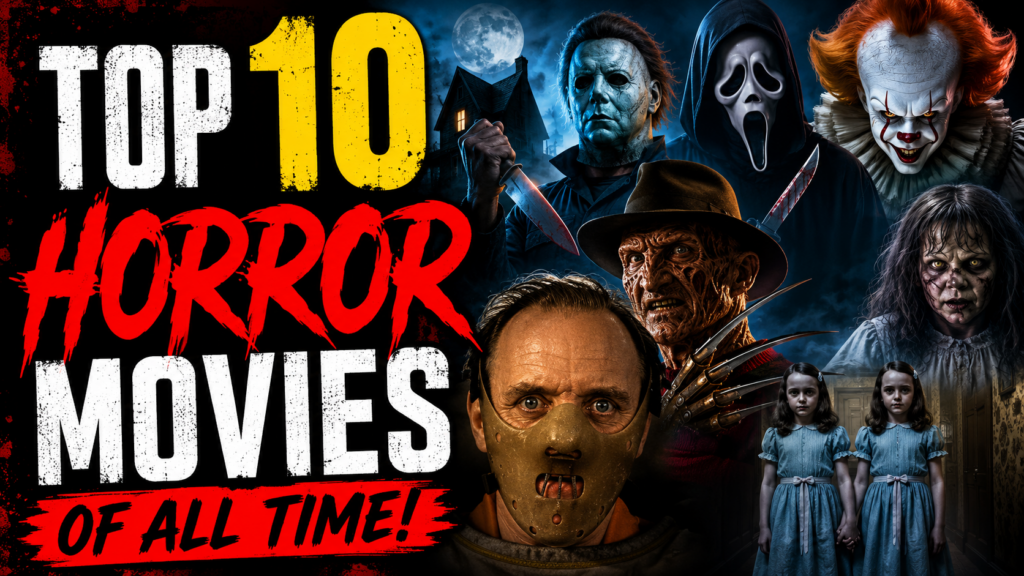
What Are the Top 10 Horror Movies of All Time ?
Horror movies have entertained, shocked, and terrified audiences for generations. From supernatural hauntings and demonic possessions to masked serial killers and terrifying creatures lurking in the darkness, the horror genre offers some of cinema’s most unforgettable experiences. The greatest horror films do more than deliver jump scares. They create suspense, explore our deepest fears, and leave viewers thinking about their disturbing stories long after the credits roll.
The top 10 horror movies of all time represent different styles of filmmaking, from psychological thrillers and supernatural nightmares to science-fiction horror and brutal slasher films. Some changed the direction of cinema, while others introduced iconic villains and unforgettable characters who continue to influence modern filmmakers.
What makes a horror movie truly great? It might be an atmosphere filled with dread, a frightening performance, a shocking twist, groundbreaking special effects, or a story that taps into universal fears. The most successful films often combine several of these elements to create something that remains frightening even decades after its original release.
In this countdown, we explore ten legendary horror movies, ranking them in descending order from number 10 to number 1. Each entry includes a plot overview, the people behind the film, its most memorable qualities, and the reasons horror fans should consider watching it.
Whether you prefer haunted houses, supernatural forces, terrifying monsters, or psychologically complex villains, this list offers a journey through some of the most influential horror films ever made.
10. Halloween (1978): The Slasher Movie That Changed Horror
Director: John Carpenter
Starring: Jamie Lee Curtis, Donald Pleasence and Tony Moran
Genre: Slasher horror, suspense
Released in 1978, Halloween is one of the most influential horror films in cinema history. Directed by John Carpenter, the movie helped establish many of the conventions associated with the modern slasher genre. Its masked killer, vulnerable teenagers, suspenseful stalking sequences, and unforgettable musical theme have inspired countless horror films.
The Story Behind Halloween
The story begins in Haddonfield, Illinois, where a young Michael Myers murders his older sister on Halloween night. After spending years confined to a psychiatric institution, Michael escapes and returns to his hometown.
Dr. Sam Loomis, Michael’s psychiatrist, believes his patient is an extremely dangerous individual and attempts to stop him before he kills again. Meanwhile, teenager Laurie Strode, played by Jamie Lee Curtis, spends Halloween looking after children while preparing for an ordinary evening.
Unfortunately, the town’s celebrations conceal a deadly threat. Michael silently follows Laurie and her friends, watching them from a distance before beginning his attack. As the night progresses, Laurie discovers that the seemingly ordinary streets of her hometown have become a hunting ground.
The film gradually transforms a familiar holiday into a terrifying struggle for survival.
Why Halloween Is a Horror Classic
One of the film’s greatest strengths is its use of suspense. Rather than constantly showing violence, Carpenter allows the audience to anticipate danger. Michael Myers frequently appears in the background, behind windows, or at the end of a street, creating a persistent sense of unease.
The character’s emotionless mask makes him particularly disturbing. Without visible expressions or dialogue, Michael becomes an almost unknowable figure. His slow, relentless movements suggest that escaping him may be impossible.
Carpenter’s minimalist musical score is equally important. Its repeating piano notes create tension before anything frightening happens, demonstrating how sound alone can make an ordinary scene feel dangerous.
Jamie Lee Curtis’s performance also helped establish Laurie Strode as a defining horror heroine. She is resourceful, vulnerable, and determined to survive despite facing an apparently unstoppable attacker.
The film’s influence can be seen throughout the slasher genre, including stories featuring masked killers, isolated victims, and elaborate Halloween-night settings.
Verdict: Halloween deserves its place among the greatest horror movies ever made because it demonstrates that atmosphere, music, and suspense can be more frightening than constant on-screen violence.
9. The Conjuring (2013): A Modern Supernatural Horror Masterpiece
Director: James Wan
Starring: Vera Farmiga, Patrick Wilson and Lili Taylor
Genre: Supernatural horror, paranormal thriller
Released in 2013, The Conjuring helped establish a new wave of mainstream supernatural horror. Directed by James Wan, the film combines haunted-house scares, unsettling supernatural events, and the emotional vulnerability of a family confronting something beyond its understanding.
The movie draws inspiration from the paranormal investigations associated with Ed and Lorraine Warren, although its dramatic events should be understood as a fictionalised horror narrative rather than independently verified supernatural evidence.
The Story Behind The Conjuring
The film follows the Perron family as they move into an old farmhouse in Rhode Island. At first, the property appears to offer the peaceful rural life they want for their children.
However, strange occurrences soon begin disrupting their home. Clocks stop at unusual times, doors move without explanation, and disturbing noises emerge from different parts of the house. The family’s experiences become increasingly frightening as a mysterious presence appears to threaten their safety.
Unable to explain what is happening, the Perrons seek help from paranormal investigators Ed and Lorraine Warren, played by Patrick Wilson and Vera Farmiga.
As the investigators examine the property, they uncover a disturbing history connected to the house. Their investigation reveals that the family may be facing something much more dangerous than an ordinary haunting.
The situation escalates into a desperate struggle to protect the children and free the family from the terrifying events surrounding them.
Why The Conjuring Stands Out
James Wan demonstrates an exceptional understanding of suspense. The film often creates fear by directing attention toward apparently empty spaces. A dark hallway, a closed door, or a quiet bedroom becomes frightening because viewers suspect that something may be hiding just outside the frame.
Sound design plays a major role. Sudden noises interrupt moments of silence, while creaking floorboards and distant voices make the farmhouse feel alive with unseen threats.
The performances also give the story emotional weight. Vera Farmiga and Patrick Wilson portray the Warrens as investigators whose personal convictions are tested by the danger they encounter. Lili Taylor’s portrayal of a frightened mother helps ground the supernatural story in the understandable fear of protecting one’s children.
The film’s success also contributed to a wider franchise of supernatural horror stories, including further investigations involving the Warrens and related characters.
Verdict: The Conjuring is an excellent choice for viewers who enjoy haunted houses, demonic mysteries, atmospheric storytelling, and carefully timed scares.
8. A Nightmare on Elm Street (1984): The Horror of Never Being Safe
Director: Wes Craven
Starring: Heather Langenkamp, Robert Englund and Johnny Depp
Genre: Supernatural slasher, fantasy horror
Wes Craven’s A Nightmare on Elm Street introduced one of horror cinema’s most recognisable villains: Freddy Krueger. Released in 1984, the film takes a simple but frightening idea and develops it into a nightmare where sleep itself becomes dangerous.
Most horror characters can be avoided by escaping a location or locking a door. Freddy’s victims face a much more disturbing problem: the killer can reach them through their dreams.
The Story Behind A Nightmare on Elm Street
The story centres on Nancy Thompson and a group of teenagers who begin experiencing frightening dreams about a disfigured man wearing a glove fitted with razor-sharp blades.
The mysterious figure is Freddy Krueger, a terrifying presence who seems capable of harming people while they sleep. As the teenagers begin dying under mysterious circumstances, Nancy realises that their nightmares are connected.
Her attempts to stay awake become increasingly desperate. Exhaustion threatens to overcome her, but falling asleep could mean entering Freddy’s deadly world.
Nancy investigates the history behind the killer and searches for a way to confront him. She must understand the rules governing the dream world before she becomes another victim.
The film blends dreamlike imagery with suspense, creating sequences in which familiar surroundings suddenly transform into disturbing and unpredictable environments.
Why This Horror Film Remains Iconic
The greatest idea in A Nightmare on Elm Street is its attack on the natural need for sleep. Everyone must eventually close their eyes, making the central threat almost impossible to escape.
Wes Craven uses surreal imagery to blur the line between reality and dreams. Walls stretch, rooms change shape, and ordinary objects become instruments of terror. These sequences give the film a distinctive visual identity.
Robert Englund’s performance helped make Freddy Krueger a horror icon. Freddy is cruel, unpredictable, and disturbingly theatrical, combining supernatural menace with a personality that distinguishes him from more silent slasher villains.
Heather Langenkamp also gives Nancy a compelling journey from frightened teenager to determined survivor. Her intelligence and willingness to fight back make her more than a passive victim.
The film spawned a major franchise and influenced later horror stories involving nightmares, dream manipulation, and supernatural killers.
Verdict: A Nightmare on Elm Street remains essential viewing because it transforms something ordinary and unavoidable into a source of relentless fear.
7. The Shining (1980): Isolation, Madness and the Haunted Hotel
Director: Stanley Kubrick
Starring: Jack Nicholson, Shelley Duvall and Danny Lloyd
Genre: Psychological horror, supernatural horror
Stanley Kubrick’s The Shining is one of the most discussed horror films ever made. Released in 1980, it combines psychological tension, supernatural mystery, disturbing imagery, and a memorable performance from Jack Nicholson.
Based on Stephen King’s novel, the film explores how isolation, family tension, and an apparently haunted environment can combine to create a nightmare.
The Story Behind The Shining
Jack Torrance accepts a job as the winter caretaker of the remote Overlook Hotel in Colorado. Hoping to concentrate on his writing, he moves into the enormous building with his wife Wendy and young son Danny.
During winter, heavy snowfall isolates the hotel from the outside world. The family initially appears to have an opportunity for peace and privacy, but strange events soon begin to undermine that expectation.
Danny possesses a mysterious psychic ability known as the shining, which allows him to experience disturbing visions and sense hidden aspects of the hotel.
As the family explores the building, they encounter unsettling rooms, unexplained figures, and evidence of a troubling past. Jack’s behaviour becomes increasingly erratic as he struggles with his writing and the oppressive isolation.
Wendy eventually realises that her husband has become a threat. Trapped inside the hotel, she must protect Danny while trying to escape the growing danger.
What Makes The Shining So Terrifying?
Unlike many conventional horror films, The Shining does not rely on a constant stream of jump scares. Its terror develops slowly through atmosphere, visual composition, and uncertainty.
The Overlook Hotel feels enormous and strangely disorientating. Long corridors, empty ballrooms, geometric carpets, and seemingly endless rooms create a world that is beautiful but deeply unsettling.
Jack Nicholson’s performance is central to the film’s impact. His portrayal of Jack Torrance moves between apparent normality, frustration, and frightening instability. The gradual transformation makes it difficult to determine exactly when the character becomes truly dangerous.
Shelley Duvall provides a contrasting performance as Wendy, whose fear grows as she recognises the threat facing her family. Danny Lloyd’s portrayal of Danny adds another layer of unease through the child’s sensitivity to the hotel’s disturbing atmosphere.
The film’s ambiguous supernatural elements encourage audiences to debate whether the hotel is genuinely haunted, whether Jack’s mental state explains some of the events, or whether both forces are operating together.
Verdict: The Shining is a masterclass in psychological horror, proving that isolation, uncertainty, and carefully constructed atmosphere can create a lasting sense of dread.
6. The Texas Chain Saw Massacre (1974): A Nightmare on a Rural Road
Director: Tobe Hooper
Starring: Marilyn Burns, Gunnar Hansen and Allen Danziger
Genre: Slasher horror, survival horror
Tobe Hooper’s The Texas Chain Saw Massacre is one of the most influential and disturbing horror films of the 1970s. Its grim atmosphere, frightening antagonist, and relentless survival story helped shape the future of slasher cinema.
The film is particularly effective because it begins with an apparently ordinary journey before turning into a desperate struggle against an unimaginable threat.
The Story Behind The Texas Chain Saw Massacre
A group of young travellers crosses rural Texas while visiting the area where members of their family once lived. Along the way, they encounter unsettling local residents and eventually arrive at an isolated farmhouse.
Their curiosity quickly turns into terror when they discover that the property belongs to a family of violent killers.
Among them is Leatherface, a towering figure who wears a mask made from human skin and uses a chainsaw as a weapon. His sudden appearance transforms the farmhouse into a place of overwhelming danger.
The travellers find themselves trapped in a nightmare, with few places to hide and no reliable way to summon help. As the situation grows more desperate, the survivors must rely on their instincts to escape.
The story unfolds with a relentless pace, leaving little opportunity for relief. The isolated setting intensifies the feeling that the characters have entered a world where ordinary rules no longer protect them.
Why The Texas Chain Saw Massacre Is a Horror Landmark
The film’s power comes partly from its rough, documentary-like atmosphere. The rural landscape appears harsh and unforgiving, while the farmhouse is filled with disturbing objects and unsettling details.
Leatherface is an especially effective antagonist because he is both physically intimidating and difficult to understand. Rather than offering elaborate explanations for his actions, the film presents him as a terrifying part of a violent and deeply disturbed environment.
Tobe Hooper also creates tension through sound. The chainsaw becomes an instantly recognisable symbol of danger, while the chaotic noise surrounding the characters heightens their panic.
Although the film is notorious for its disturbing reputation, much of its impact comes from suggestion, frantic editing, and the reactions of the characters rather than graphic imagery alone.
Its influence can be seen in countless later slasher films featuring isolated settings, relentless pursuers, and groups of young people fighting to survive.
Verdict: The Texas Chain Saw Massacre remains a landmark of survival horror because it creates a world of relentless fear and makes escape feel almost impossible.
5. Alien (1979): The Ultimate Science-Fiction Horror Nightmare
Director: Ridley Scott
Starring: Sigourney Weaver, Tom Skerritt and John Hurt
Genre: Science-fiction horror, creature feature
Ridley Scott’s Alien transformed science-fiction cinema by combining the mystery of space exploration with the terror of a creature that hunts humans inside a confined environment.
Released in 1979, the film helped establish Ellen Ripley as one of cinema’s most memorable survival protagonists. It also introduced an extraterrestrial creature whose unusual design and terrifying life cycle became central to the franchise’s identity.
The Story Behind Alien
The commercial spaceship Nostromo is travelling through space when its computer detects a mysterious signal from an unexplored location. The crew investigates and discovers a strange spacecraft containing unfamiliar organic structures.
During the investigation, one crew member encounters an alien organism that attaches itself to his face. The crew brings him back aboard despite the danger, hoping to understand what happened.
Their decision has disastrous consequences. The creature’s life cycle develops in an unexpected and violent way, leaving the crew facing an organism they cannot control.
As the alien grows stronger, it begins hunting the crew through the ship’s narrow corridors and hidden compartments. Communication with the outside world offers little reassurance, and the survivors discover that their own vessel has become a deadly trap.
Officer Ellen Ripley emerges as a determined figure who attempts to understand the threat and find a way to survive.
Why Alien Is One of the Greatest Horror Movies
One of the film’s greatest strengths is its setting. The Nostromo feels like a working industrial vessel rather than a glamorous spacecraft. Pipes, machinery, dim lighting, and cramped corridors make the environment feel tangible and oppressive.
The alien itself remains frightening because the crew knows so little about it. Its biology, motives, and capabilities are initially mysterious, creating suspense around every encounter.
The creature’s design, associated with artist H. R. Giger, combines biomechanical shapes with disturbing organic features. This gives the alien an appearance unlike anything audiences had previously encountered in mainstream science-fiction cinema.
Sigourney Weaver’s performance as Ripley is equally important. Ripley is intelligent, observant, and increasingly determined as the situation deteriorates. Her struggle is not about becoming a superhero; it is about making difficult decisions under extreme pressure.
The film also explores themes of corporate greed, human vulnerability, and the dangers of treating unknown life as a resource to be exploited.
Its success helped establish a major science-fiction horror franchise, but the original film remains distinctive for its slow-building tension and claustrophobic atmosphere.
Verdict: Alien earns its place among the greatest horror movies ever made by combining creature horror, suspense, memorable design, and one of cinema’s strongest survival stories.
4. The Exorcist (1973): A Terrifying Story of Demonic Possession
Director: William Friedkin
Starring: Ellen Burstyn, Linda Blair, Jason Miller and Max von Sydow
Genre: Supernatural horror, possession horror
William Friedkin’s The Exorcist is widely regarded as one of the defining supernatural horror films. Released in 1973, it follows a mother’s desperate attempt to save her daughter when medical explanations appear unable to account for a series of disturbing events.
The film’s combination of realistic performances, religious themes, and disturbing imagery helped establish its reputation as one of horror cinema’s most unsettling experiences.
The Story Behind The Exorcist
The story centres on Chris MacNeil, an actress living in Washington, D.C., with her young daughter Regan. Their ordinary lives begin to change when Regan starts displaying strange behaviour and experiencing increasingly disturbing physical and psychological symptoms.
At first, Chris seeks medical assistance, hoping that doctors can identify the cause. However, the tests and treatments fail to provide a convincing explanation for what is happening.
As Regan’s condition becomes more frightening, Chris begins to consider the possibility that something supernatural is involved. She eventually seeks help from Father Damien Karras, a priest who is struggling with his own doubts and personal difficulties.
Karras consults the experienced Father Merrin, and together they attempt to confront the entity believed to be possessing Regan.
Their task becomes a battle of faith, courage, and endurance. As the exorcism progresses, the priests face a force that appears determined to destroy both the child and the people trying to save her.
Why The Exorcist Still Frightens Audiences
The film’s effectiveness comes from the contrast between ordinary life and extraordinary terror. Chris’s home initially appears warm and familiar, making the disturbing changes in Regan all the more unsettling.
Linda Blair’s performance is central to the film’s impact. She portrays Regan’s transformation in a way that makes the situation deeply upsetting for her mother and the people trying to help.
Ellen Burstyn provides the emotional foundation of the story. Chris is not a professional monster hunter or a fearless action hero; she is a parent searching for a way to save her child.
The film also examines the relationship between faith and doubt. Father Karras’s personal struggles give the supernatural story an emotional dimension, while Father Merrin represents experience in confronting the apparent evil.
Rather than presenting the exorcism as a simple battle between good and evil, the film makes the confrontation feel physically exhausting and spiritually dangerous.
Its influence on later possession films is enormous. Many modern supernatural horror movies borrow elements of its structure, imagery, and emphasis on the suffering of families confronted by apparently inexplicable events.
Verdict: The Exorcist remains one of the greatest supernatural horror films because it combines intense performances, religious themes, emotional stakes, and unforgettable moments of terror.
3. Psycho (1960): Alfred Hitchcock’s Masterpiece of Psychological Horror
Director: Alfred Hitchcock
Starring: Anthony Perkins, Janet Leigh, Vera Miles and John Gavin
Genre: Psychological horror, thriller, mystery
Alfred Hitchcock’s Psycho is one of the most influential films in the history of suspense cinema. Released in 1960, it challenged audience expectations and helped reshape the psychological thriller and horror genres.
Rather than relying on supernatural creatures or elaborate monsters, the film builds its fear around human behaviour, hidden identities, and the unsettling possibility that ordinary appearances can conceal disturbing secrets.
The Story Behind Psycho
Marion Crane is a secretary who steals money from her employer and leaves town, hoping to begin a new life. During her journey, she stops at the isolated Bates Motel, where she meets its polite but nervous manager, Norman Bates.
Norman lives in a nearby house with his mother, whose presence seems to influence his behaviour. During their conversation, Marion senses that the young man is troubled by his unusual family circumstances.
The motel appears quiet, but its isolation and Norman’s strange relationship with his mother create an atmosphere of unease. As the story unfolds, a shocking event changes the direction of the narrative and launches an investigation into the secrets surrounding the Bates family.
The mystery deepens as other characters attempt to discover what happened to Marion and uncover the truth about the motel.
Hitchcock carefully controls what the audience knows, using misdirection and suspense to challenge assumptions about the characters and the story itself.
Why Psycho Changed Horror Cinema
One of the film’s most famous sequences is its shower scene, which demonstrates Hitchcock’s ability to create terror through editing, sound, and implication. The scene became one of the most recognisable moments in cinema, despite the violence being conveyed largely through suggestion rather than explicit imagery.
Anthony Perkins gives Norman Bates a remarkable performance. His character appears shy, polite, and vulnerable, but small gestures and awkward conversations hint at something more disturbing beneath the surface.
Janet Leigh also makes Marion a compelling character whose choices set the story in motion. The film encourages viewers to form assumptions before abruptly challenging their understanding of the narrative.
The Bates Motel itself is an iconic location. Its isolated position, darkened windows, and looming house create an atmosphere that suggests the characters have entered a place where ordinary expectations no longer apply.
The film’s influence extends beyond horror. Its use of narrative misdirection, psychological tension, and shocking structural changes helped shape generations of thrillers and mystery films.
Verdict: Psycho is essential viewing for anyone interested in horror cinema because it proves that suspense and the fear of human behaviour can be just as powerful as supernatural terror.
2. The Thing (1982): Paranoia in the Frozen Wilderness
Director: John Carpenter
Starring: Kurt Russell, Keith David and Wilford Brimley
Genre: Science-fiction horror, creature horror
John Carpenter’s The Thing is one of the most celebrated examples of science-fiction horror. Set in an isolated Antarctic research station, the film combines a terrifying alien threat with psychological suspense and a constant sense of mistrust.
Released in 1982, the movie was initially met with a mixed reception but later developed a devoted following. Today, it is frequently praised for its practical effects, tense atmosphere, and exploration of paranoia.
The Story Behind The Thing
A group of American researchers stationed in Antarctica encounters a strange sequence of events involving a dog pursued by men from a nearby Norwegian research base.
The situation soon reveals something far more disturbing. The dog is connected to an alien organism capable of imitating other living creatures, including human beings.
The creature can transform its body and reproduce the appearance of its victims with terrifying accuracy. As a result, the researchers cannot be certain whether the people around them are still human or have been replaced by the alien.
The station’s isolation makes the problem almost impossible to solve. The freezing wilderness surrounds the facility, communication is limited, and the survivors have few opportunities to escape.
MacReady, played by Kurt Russell, attempts to organise the group and discover a way to identify the creature. But fear and suspicion steadily undermine their cooperation.
Every conversation becomes potentially dangerous because the enemy may be hiding behind a familiar face.
Why The Thing Is a Horror Masterpiece
The film’s central idea is brilliantly frightening: the monster does not simply attack from the shadows. It can become someone the characters trust.
This uncertainty transforms the research station into a psychological battlefield. The characters must decide whether to cooperate, investigate, or defend themselves against people who might be innocent.
Rob Bottin’s practical creature effects are another major reason for the film’s enduring reputation. The alien transformations are grotesque, unpredictable, and physically disturbing. They create a sense that the creature’s biology operates according to rules beyond human understanding.
Carpenter also makes excellent use of the setting. The endless snow, freezing temperatures, and isolation ensure that the environment itself becomes an enemy. Even if a character survives an encounter with the creature, escaping the Antarctic may be impossible.
Kurt Russell’s performance as MacReady gives the story a strong central figure without making him invulnerable. His decisions are often desperate responses to incomplete information, reinforcing the film’s atmosphere of uncertainty.
The film’s bleak tone and unresolved questions also encourage repeated viewings. Audiences can examine character behaviour, dialogue, and visual details while debating exactly what happened.
Verdict: The Thing is one of the finest science-fiction horror films ever made because it combines groundbreaking practical effects with paranoia, isolation, and a terrifyingly intelligent monster.
1. The Silence of the Lambs (1991): The Ultimate Psychological Horror Thriller
Director: Jonathan Demme
Starring: Jodie Foster, Anthony Hopkins, Scott Glenn and Ted Levine
Genre: Psychological thriller, crime horror
Taking the number one position in this countdown is The Silence of the Lambs, the acclaimed 1991 film directed by Jonathan Demme. Although often classified as a psychological thriller and crime drama, the movie contains many of the qualities that make great horror so disturbing: a terrifying antagonist, a sense of vulnerability, disturbing crimes, and an atmosphere of constant psychological danger.
Its story explores the relationship between a young FBI trainee and an imprisoned serial killer whose intelligence makes him both valuable and frightening.
The Story Behind The Silence of the Lambs
Clarice Starling is an ambitious FBI trainee who is assigned to interview Dr. Hannibal Lecter, a brilliant psychiatrist imprisoned for murder and cannibalism.
The FBI hopes that Lecter can provide insight into another serial killer known as Buffalo Bill, who abducts women and murders them. Investigators believe Lecter’s understanding of criminal psychology may help them identify and capture the killer before another victim is harmed.
However, Lecter refuses to cooperate straightforwardly. He manipulates conversations, studies Clarice’s reactions, and demands personal information in exchange for his assistance.
Clarice must navigate this dangerous relationship while continuing to investigate Buffalo Bill’s crimes. Each meeting with Lecter becomes a psychological contest in which a careless remark could give the imprisoned killer an advantage.
As the investigation progresses, Clarice uncovers clues that bring her closer to understanding Buffalo Bill’s identity and motives.
The final stages of the story place her in a terrifying situation where she must rely on her intelligence, training, and courage to survive.
Why The Silence of the Lambs Deserves the Top Spot
The film’s most remarkable quality is its use of psychological tension. Hannibal Lecter is frightening not because he constantly threatens people with physical violence, but because he understands how to manipulate them.
Anthony Hopkins delivers an unforgettable performance through controlled movements, precise dialogue, and an unnervingly direct gaze. Lecter appears composed even when discussing disturbing subjects, making his intelligence seem more dangerous than any display of anger.
Jodie Foster provides an equally compelling performance as Clarice Starling. Her character is intelligent and determined, but she is also a young investigator operating in an environment where her experience is limited and the consequences of failure are severe.
The relationship between Clarice and Lecter forms the film’s emotional and psychological centre. Their conversations reveal information about the investigation while exposing aspects of Clarice’s past and personality.
Director Jonathan Demme frequently places the audience close to the characters, making their expressions and reactions central to the tension. This technique makes even a quiet conversation feel threatening.
The film also explores themes of identity, ambition, vulnerability, trauma, and the disturbing ways people attempt to understand violence. Its horror comes from human behaviour rather than supernatural forces, giving the story an unsettling connection to reality.
The performances, screenplay, direction, and atmosphere helped establish The Silence of the Lambs as one of the most acclaimed thrillers of its era. Its impact continues to influence crime dramas and psychological horror stories.
Verdict: The Silence of the Lambs takes the top position because of its extraordinary performances, intelligent storytelling, disturbing villain, and ability to generate fear through psychological manipulation rather than conventional horror tricks.
What Makes These the Greatest Horror Movies of All Time?
The ten films in this countdown demonstrate that horror is not a single style of filmmaking. The genre includes supernatural stories, psychological thrillers, slasher films, science-fiction nightmares, and survival horror.
Although these movies approach fear in different ways, they share several qualities that help explain their lasting influence.
1. Memorable Villains and Monsters
Horror villains often become cultural icons. Michael Myers, Freddy Krueger, Leatherface, Hannibal Lecter, and the alien from Alien each represent different forms of danger.
Some are frightening because they appear unstoppable. Others are terrifying because they understand human behaviour or can imitate the people around them.
A memorable antagonist gives the audience a reason to fear what might happen next, even when the character is not visible on screen.
2. Atmosphere and Suspense
The greatest horror films understand that fear can begin before anything dangerous happens.
The empty corridors of the Overlook Hotel, the isolated Antarctic station in The Thing, and the darkened farmhouse in The Conjuring all create environments where audiences expect something terrible to happen.
Lighting, music, sound design, camera movement, and editing work together to turn ordinary locations into threatening spaces.
3. Characters Worth Caring About
Horror becomes more effective when viewers care about the people in danger.
Laurie Strode’s determination, Ellen Ripley’s intelligence, Clarice Starling’s ambition, and the Perron family’s desire to protect their children give these stories emotional weight.
The audience is not simply watching frightening events. It is hoping that the characters will find a way to survive.
4. Original Ideas That Challenge Expectations
The best horror movies introduce concepts that continue to feel disturbing long after the films have ended.
A Nightmare on Elm Street makes sleep dangerous. The Thing turns trust into a potential weakness. Psycho challenges the audience’s assumptions about the story itself, while Alien combines the unknown dangers of space with the claustrophobia of a confined vessel.
These concepts give the films identities that distinguish them from ordinary thrillers.
5. Lasting Influence on Cinema
A great horror movie does more than frighten its original audience. It changes how future filmmakers approach storytelling.
Halloween influenced the slasher genre, Psycho helped redefine psychological suspense, The Exorcist became a major reference point for possession horror, and Alien demonstrated how effectively science fiction and horror could work together.
Their influence is visible in countless later films, television series, games, and popular-culture discussions.
Which Horror Movie Is the Scariest of All Time?
Choosing the scariest horror movie is ultimately a matter of personal preference. Different viewers respond to different forms of fear, and a film that terrifies one person may have a completely different effect on another.
For fans of supernatural horror, The Exorcist and The Conjuring offer disturbing stories involving apparently unexplained forces. Their tension comes from the possibility that familiar homes and ordinary family life can be invaded by something beyond human understanding.
Viewers who prefer psychological horror may find The Shining, Psycho, or The Silence of the Lambs more effective. These films explore madness, manipulation, and the unsettling behaviour of people who appear normal at first.
For slasher fans, Halloween and A Nightmare on Elm Street feature iconic killers and memorable survival stories. Meanwhile, The Texas Chain Saw Massacre offers a particularly intense experience built around isolation, brutality, and the struggle to escape.
Science-fiction horror enthusiasts may prefer Alien or The Thing. Both films explore the dangers of encountering an unfamiliar organism, but they approach that threat in different ways. Alien emphasises the relentless pursuit of a single creature, while The Thing creates uncertainty about who can be trusted.
The best choice depends on the type of horror you enjoy. However, all ten films deserve consideration because of their influence, distinctive storytelling, and ability to leave a lasting impression.
Frequently Asked Questions About the Top 10 Horror Movies of All Time
What is the number one horror movie of all time?
In this countdown, The Silence of the Lambs (1991) takes the number one position because of its psychological tension, memorable performances, and disturbing portrayal of criminal manipulation. However, there is no universally accepted winner, and many horror fans would choose The Exorcist, Psycho, or The Shining instead.
What is considered the scariest horror movie ever made?
There is no definitive answer because fear is subjective. The Exorcist is famous for its possession story, The Shining is celebrated for its psychological atmosphere, and The Texas Chain Saw Massacre is renowned for its raw intensity. The scariest film for an individual viewer depends on the themes and situations they find most frightening.
What is the best classic horror movie?
Several classic horror movies are essential viewing, including Psycho (1960), The Exorcist (1973), The Texas Chain Saw Massacre (1974), and Halloween (1978). Each helped shape the genre through distinctive storytelling, memorable characters, or influential filmmaking techniques.
Which horror movie has the most memorable villain?
That depends on the type of antagonist you prefer. Michael Myers is known for his silent, relentless presence, Freddy Krueger is famous for attacking victims in their dreams, and Hannibal Lecter is frightening because of his intelligence and psychological manipulation. The alien in Alien and the shape-shifting creature in The Thing also rank among the genre’s most distinctive monsters.
Are these horror movies suitable for younger viewers?
These films were generally made for mature audiences and include disturbing themes, violence, frightening imagery, or intense psychological situations. Parents and viewers should check the relevant age classification and content guidance before watching, particularly when considering younger audiences.
What should I watch first if I am new to horror movies?
Halloween is a strong introduction to classic slasher horror, while The Conjuring offers a modern supernatural experience. Alien is an excellent choice for science-fiction fans, and Psycho provides an introduction to psychological suspense. Viewers who prefer more intense and disturbing stories may want to explore The Exorcist or The Texas Chain Saw Massacre.
Why do people enjoy watching horror movies?
Horror movies allow viewers to experience fear in a controlled environment. Suspense, adrenaline, mystery, surprising twists, and the satisfaction of seeing characters overcome danger can all contribute to the appeal. For many fans, horror also provides an opportunity to explore difficult themes and discuss what frightens people.
Conclusion: The Greatest Horror Movies Continue to Haunt Us
The top ten horror movies in this countdown demonstrate why the genre remains such an important part of cinema. From John Carpenter’s masked killer in Halloween to the psychological menace of The Silence of the Lambs, these films explore fear through memorable characters, carefully constructed suspense, and stories that challenge our sense of safety.
The Conjuring demonstrates the power of supernatural atmosphere, A Nightmare on Elm Street turns sleep into a nightmare, and The Shining explores the frightening consequences of isolation. The Texas Chain Saw Massacre delivers an intense survival story, while Alien and The Thing show how science fiction can create some of the most disturbing horror experiences imaginable.
Meanwhile, The Exorcist remains a defining supernatural classic, and Psycho continues to influence psychological thrillers decades after its release.
Ultimately, no single ranking can settle the debate over the greatest horror movies ever made. New generations discover these classics, reinterpret their themes, and compare them with modern releases.
Whether you prefer supernatural terror, psychological suspense, slasher villains, or terrifying creatures, these ten films offer an excellent starting point for exploring horror cinema.
Which movie would you rank number one? Share your favourite horror films and your own rankings, and keep following Epic Heroes for more movie lists, entertainment features, and pop-culture countdowns.
Follow us for New Content Daily
Web – www.epicheroes.com
Twitter @epicheroes
Insta @epicheroesuk
http://www.youtube.com/c/Epicheroes


