 Epic Heroes Entertainment Movies Toys TV Video Games News Art Pop culture news goodness
Top 5 Martial Arts Manga and Manhwa You Should Read
Top 5 Martial Arts Manga and Manhwa You Should Read
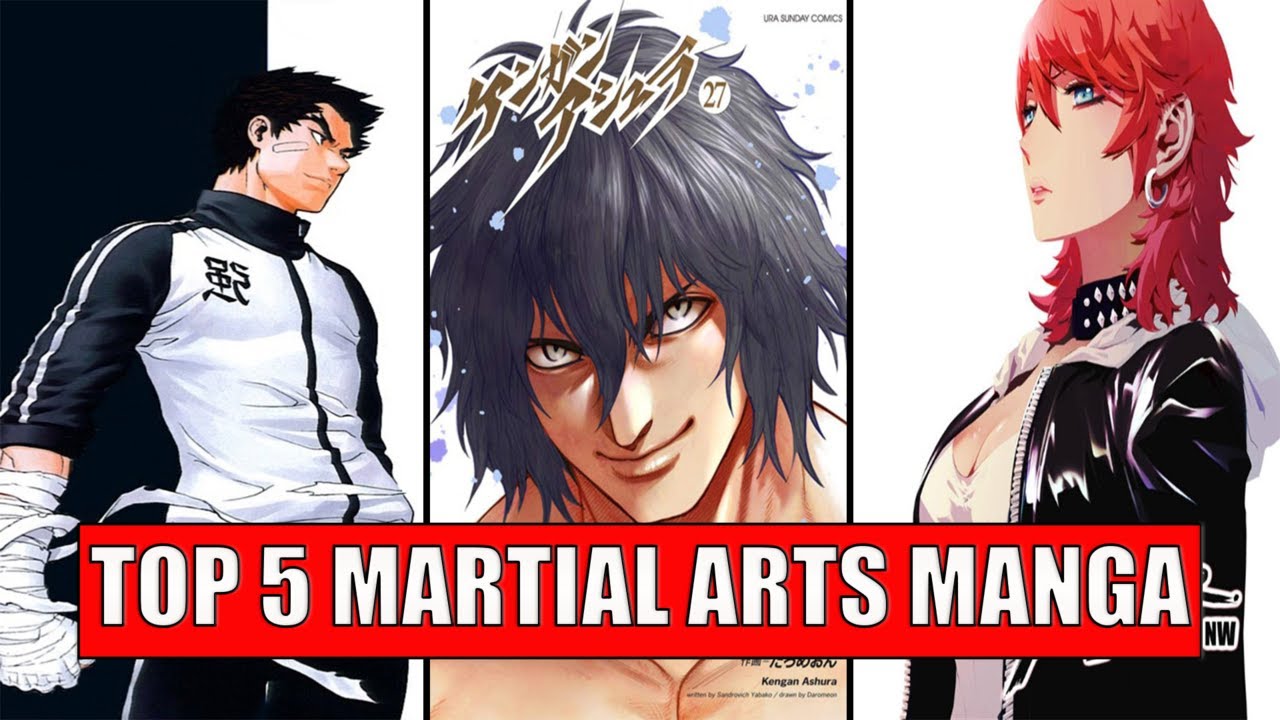
I love fighting anime. I grew up watching Dragon Ball Z, Naruto, and One Piece. They each had jaw dropping fights that I remember to this day. But as I’ve gotten older, I’ve been finding it increasingly hard to find good fighting anime. Obviously there’s stuff like Baki and Hajime No Ippo but after awhile I needed something more. That’s why I turned to manga. More specifically martial arts manga. And today I’ve decided to bless your lives with five martial arts manga & manhwa that I think you should all be reading in 2020.
Top 5 Martial Arts Manga included in this video:
1) #Kengan Ashura – Martial Arts Manga
Kengan Ashura is a Japanese manga series written by Yabako Sandrovich and illustrated by Daromeon. It was serialized on Shogakukan’s Ura Sunday website from April 2012 to August 2018, with its chapters compiled into twenty-seven tankōbon volumes. A sequel, titled Kengan Omega, began in January 2019. It was adapted into an original net animation (ONA) anime series. The first 12-episode part premiered in July 2019 through Netflix. The second 12-episode part premiered in October 2019
Since the Edo period of Japan, gladiator arenas have existed in various forms around the world. In these arenas, wealthy business owners and merchants hire gladiators to fight in unarmed combat where the winner takes all, called Kengan matches. Yamashita Kazuo, an average Japanese salaryman for Nogi Group witnesses a street fight in an alley between two mysterious fighters. One of the fighters, Tokita “Ashura” Ohma is scouted out by the Nogi Group CEO, Nogi Hideki, due to defeating their previous fighter in the street fight. Kazuo is roped into managing Ohma who joins these arenas only to devastate his opponents. His spectacular ability to crush his enemies catches the attention of big business owners, leading to his inclusion in the Kengan Annihilation Tournament under the invitation of Hideki. This tournament is held by the biggest CEOs in Japan and the winner gets the seat of Kengan Association chairman, a position which holds immense power and prestige. As the tournament unfolds Ohma tests his strength while struggling with his mysterious past coming back to haunt him as Kazuo struggles with managing Ohma and figuring out the true intentions as to why he was invited to this tournament.
2) #TheBreaker – Martial Arts Manga
The Breaker is a South Korean manhwa series written by Jeon Geuk-jin and illustrated by Park Jin-hwan under the pen name Kamaro. The Breaker was serialized in Daiwon C.I.’s Young Champ’s magazine between June 2007 and July 2010. It is followed by The Breaker: New Waves (브레이커NW; Beureikeo NW) which is published on Daum Communications’ online comics portal beginning 2010.
The story follows Shiwoon Yi, a timid high school student who becomes the disciple to Chunwoo Han, a martial artist who is an enemy to the secret martial arts society known as the Murim. The Breaker has been localized outside of Korea into other languages such as French, German, Italian, Russian, and Polish.
Chunwoo Han is a martial artist who earned the title of Nine Arts Dragon from the Murim, a secret martial arts society that exists in harmony with modern society. The Murim’s government is the Martial Arts Alliance who has garnered Chunwoo’s hatred by killing his martial arts teacher. In the present, Chunwoo Han transfers to a fictional school in Seoul for a mission given to him by the Black Forest Defense Group, an anti-government group who opposes the Martial Arts Alliance. At the school, he meets the protagonist Shiwoon Yi. To solve his bullying problem, Shiwoon has Chunwoo train him in martial arts. Chunwoo initiates his mission and frees Sosul, the head of the Sunwoo Clan, from the Martial Arts Alliance.
As Chunwoo prepares to leave the country, the Martial Arts Alliance take Shiwoon hostage, forcing him to intervene. In the conflict, Chunwoo publicly renounces Shiwoon as his disciple and destroys his Qi-center which cripples his potential as a martial artist. In doing so, Shiwoon is no longer considered part of Murim and will be protected by law from martial artists who wish to take revenge on Chunwoo through Shiwoon. In the aftermath, Shiwoon is greeted by the Sunwoo Clan who reveal Sosul has named him as her successor.
The sequel The Breaker: New Waves continues with Shiwoon who has declined his position as the head of the Sunwoo Clan. Meanwhile, the Martial Arts Alliance is losing its control over the world and a new group, acronymed SUC, begins terrorizing normal citizens under the name of the Nine Arts Dragon. Shiwoon becomes acquainted with Sera Kang who arranges a series of events and successfully restores Shiwoon’s Qi-center. After learning about the existence of SUC, Shiwoon resolves to destroy them for tarnishing his teacher’s name.
3) #Veritas – Martial Arts Manga
Veritas is a manhwa written by Yoon Joon-shik and illustrated by Kim Dong-hoon . Its first chapter was released in 2005, and it was produced until 2010. The story is of a middle-schooler named Gangryong Ma, who is saved one day by a remarkably strong man, Lightning Tiger, who becomes his master, and teaches him a martial art known as the Enlightenment Of Thunder and Lightning (or EOTL), thereby introducing him to a world of power that will change his life forever.
Gangryong Ma was the boss of his middle school, getting in fistfights almost every day. He thought that winning those fistfights was what it meant to be strong. That all ended when he met Lightning Tiger, a man whose power dwarfed that of any man Gangryong had ever met before. After arguing, begging, and jumping through hoops for a year to prove his loyalty, Gangryong convinced Lightning Tiger to be his master.
For two months, Lightning Tiger taught Gangryong the secret of ki manipulation by way of the Enlightenment Of Thunder and Lightning (EOTL), a traditional Korean martial art passed on through the centuries to one student at a time. By properly refining and focusing his Ki, Gangryong learned not only to increase his overall physical strength, but he gained the ability to create devastatingly powerful lightning attacks. When the two months were up, Lightning Tiger left Gangryong, warning him of an inevitable battle against a strong enemy and hoping that they might one day see each other.
Months later, Gangryong was approached by an ominous group of men. He was presented with a box, and was told that it contained the arm of Lightning Tiger, whom they had supposedly killed. These men were from Reunion, a multinational organization whose main goals were the collection, evolution and eventual perfection of traditional martial arts and the creation of artificial ki, or natural energy, which could be used to make people more powerful. They forced Gangryong to enter a special school designed to train suitable fighters in the fighting styles that had been collected and created by Reunion.
Now, within Reunion, Gangryong finds himself a flash-point for controversy. As student of a sworn enemy of Reunion, there are many who want him dead. As the sole practitioner of EOTL, there are many who desire to see his success, so that they may use his techniques. All the while, Gangryong must work to uncover the secrets in the training he was given, so that he may achieve the power he seeks, and finally avenge the presumed deceased Lightning Tiger.
4) #Rikudou – Martial Arts Manga
5) #Gosu – Martial Arts Manga
Gosu is a Korean term used to refer to a highly skilled person. In computer gaming the term is usually used to refer to a person who dominated games like StarCraft, Counter-Strike, Tekken, Warcraft III, Diablo II (Godu) aka resurrexion , DotA, League of Legends, Heroes of the Storm, Overwatch, Apex Legends and others. The term was adopted by gaming communities in many countries because of a large South Korean presence in online gaming communities
The term is Sino-Korean vocabulary, and cognates in other East Asian languages that feature the same hanja (高手, literally “high hand”) include gāoshǒu (Mandarin, “expert; ace; master”), and cao thủ (Vietnamese, “skilled person; master”). In the dialect of the Gyeongnam province, gosu also has the meaning of “leader”.Figuratively meaning pro or highly skilled at something, gosu’s pre-computing usage usually referred to martial arts or the game of go.
Music: Last Night – LAKEY INSPIRED
https://www.youtube.com/watch?v=y9E0tfsZaOU
Follow my socials:
Instagram – https://www.instagram.com/nhattylitemedia/?hl=en
Discord – https://discord.gg/qTkbfke
“Copyright Disclaimer, Under Section 107 of the Copyright Act 1976, allowance is made for ‘fair use’ for purposes such as criticism, comment, news reporting, teaching, scholarship, and research. Fair use is a use permitted by copyright statute that might otherwise be infringing. Non-profit, educational or personal use tips the balance in favor of fair use.”
You don’t need to read this – The five best martial arts manga, manhwa, and Webtoons to read in 2020 are Kengan Asura, The Breaker, Veritas, Rikudo, and Gosu. This includes the sequels Kengan Omega and The Breaker New Waves. These are the top manga that need an anime right now. You’ll like these if you like Baki the Grappler.
#MartialArts #KenganAshura #Manga #Manwha
https://www.epicheroes.com/2020/10/14/top-10-best-supernatural-romance-fantasy-anime/
#Top5 #MartialArtsManga and #Manhwa You Should #Read #mangaanime #animemanga
Follow us for New Content Daily
Web – www.epicheroes.com
Twitter @epicheroes
Insta @epicheroesuk
http://www.youtube.com/c/Epicheroes